The Archive calls, and you will answer. You have no other choice.Archive Zeta is a semi-casual episodic RP centering on a mysterious organization with loose government ties of the same name, dedicated to finding items harboring unimaginable power and preventing them from ruining the world’s day. The group focuses on collaborative storytelling and worldbuilding through Episodes, self-contained missions run by mods and members alike.Touchstones: Warehouse 13, SCP Foundation,
The Librarians, Control, Darkside Detective.
STATUS:
CLOSED
Mods and players both deserve your respect. Homophobia, transphobia, antisemitism, islamophobia, etc., as well as petty drama will not be tolerated.
All players must be 18+. Anyone caught lying about their age will be banned immediately.
This group centers around investigating mysteries and items of historical value and explores darker themes such as violence, psychological horror, and isolation. We also focus on events and people that have made their mark on history, regardless of whether that mark was positive or not. Please keep this in mind when applying!
All players must adhere to the trigger list in the server, which lists both topics that are not permitted by any means and topics that may be discussed using spoiler tags and warnings.
Please keep personal drama out of the server. If you are having issues with another player, we ask you to attempt to solve the issue privately before consulting a mod.
While art is not the focus of the RP, art theft and tracing are 100% not tolerated.
AI art and AI writing are also not permitted under any circumstances.
Please be respectful of your fellow players’ boundaries. Do not shipchase, godmod, or metagame. If you want to see a development between your OC and another player’s, communicate with them. You never know if you don’t ask!
Anything can happen in RP, but don’t let circumstances in-universe affect how you treat others out of it.
Don’t be afraid to reach out to the mods if you’re having issues!
Do you have a question that's not on here? Feel free to look into our preserver FAQ document. Still have unanswered questions? You can ask us on our socials or in #help-desk.
Q) Do I need to know anything about the inspiring medias to understand the roleplay?
A) Nope! You don’t need to know anything about them at all.Q) Can my character die?
A) Not in Season One!Q) Will there be a Season Two?
A) Good question!Q) Is there an overarching plot?
A) Yes! However, the group’s main focus is artifact collection. While there is definitely a lore and a story, the artifacts are the stars here. We also have a timeline that gets updated after group events so players can keep up with the story.Q) How many OCs am I allowed to make?
A) Just one for now! We will consider seconds for the future.Q) Does my OC need to be from the United States?
A) Yes! They can be an immigrant, of course, but they need to be a citizen of the U.S.Q) Do I need to draw my own art for the app?
A) Nope! You are free to use commissioned art so long as you credit the artist. In fact, you don’t need art for your app at all—a Picrew (with a link) or even a written description will do just fine. If you do draw, we require at least a colored waist-up sketch.Q) What's the font for the visual application?
A) It's JMH Typewriter! The title font is Backfired.Q) Do I need to be active in the preserver to get in?
A) Not at all! We understand what it’s like to get into a preserver and be overwhelmed. However, mods will take note of poor behavior in the preserver and this may affect your chances.Q) Can my character have a gun?
A) Many Archive agents are sourced from US intelligence agencies such as the CIA, FBI, ATF, etc., so yes, your character can have a gun.Q) When does Archive Zeta take place?
A) 2018! Modern times. You can take a look at our timeline to catch up.
LORE
ARTIFACTS.
artifact /ˈɑrtɪfækt/ noun.
1) a usually simple object (such as a tool or ornament) showing human workmanship or modification as distinguished from a natural object;
2) something characteristic of or resulting from a particular human institution, period, trend, or individual;
3) something or someone arising from or associated with an earlier time especially when regarded as no longer appropriate, relevant, or important;
4) an object beyond human understanding.
An object, a person, and a moment.When these three things collide, an artifact waits among the settling dust.Artifacts are ordinary objects granted extraordinary properties, imbued with the power of a person or a moment. These people or moments often go on to be retold in history books; hence, many artifacts can be traced to people or happenings of historical significance. These properties vary greatly, from a hairbrush that turns you blonde and boxing gloves that let you see stars to stones that force you to dance to death and a jar of molasses that seeks to suffocate its victims. The only thing that is predictable about artifacts is their wild unpredictability.Most artifacts require some kind of human interaction in order to function: they were made by people, so they need people in order to work. People who use (or are used by) artifacts, knowingly or otherwise, are referred to as Beholders.While many artifacts have positive effects, or many beholders believe they can use the artifact for good, it’s important to remember the one rule that applies to all artifacts: there’s always a downside. While it may not be obvious at first, most artifacts have an extreme negative consequence to their use far outweighing any positive benefits, one that only worsens with repeated usage. As every artifact is unique, there is no knowing what the downside will be until it’s used.Artifacts in the wild, more often than not, cause trouble. When they cause trouble, the Archive steps in, sending agents in to neutralize the threat and bring it back to the Archive where it is safely stored.The agents’ mission is simple in concept, difficult in practice: find whatever is about to ruin the world’s day and put a stop to it.
THE ARCHIVE.
Matter cannot be created nor destroyed. Similarly, artifacts cannot be razed from existence once created; though they may be broken, burned, or melted, their fragments and molecules still contain great power. The best option, then, is to lock artifacts away where they cannot harm the world and those living in it. This is the Archive’s purpose: to seal the unknown away and prevent it from bringing harm to the world.
▶ THE FIRST ARCHIVE.
The first Archive was founded in 336 BC by Alexander the Great, who designated a facility to house the various artifacts he collected through his war campaigns. This, however, was shortlived, as he succumbed to illness and poisoning less than a decade later. The Archive truly got its start in its next location—Alexandria, Egypt, where it flourished under the Ptolemaic Dynasty.It was this Archive that began to take shape into the modern Archive of today, as it was the first that established a system of rules and control. It was also the first to assemble a formal cabinet that would oversee the Archive’s activity, made up of some of the first Archive agents. This hierarchical structure has been echoed in Archives through the ages and exists in a refined form in modern day.
▶ THE CURRENT ARCHIVE.

The current Archive is a massive building located somewhere outside Harphurst, Wyoming, built into the mountain range. From the outside, this building is only notable in its size, as it is otherwise plain. On closer inspection, however, it is bursting with high-security measures to prevent access from outsiders.
The Archive building contains thousands of artifacts collected over dozens of centuries by all the Archives before it. It is a complex, labyrinthine structure that somehow manages to feel bigger on the inside than it appears. (Agents have reported working there for years and never seeing an outside wall.) There is always room to accommodate the new artifacts the agents add to its collection. Neutralizer—a viscous, purple liquid that is the only known universal means of returning artifacts to their deactivated state—flows through the Archive like blood, keeping the artifacts stored within calm.
▶ ARCHIVE PERSONNEL.
The Archive is more than just a building—it’s alive, maintained through a connection with the Archive’s Keeper, a mysterious figure the Archive both adores and protects. The Keeper is also often the one to contact new agents about their new employment situation. They are directly above the senior agent, the Archivist, in terms of command, and so will sometimes pass orders down through him. While they do not visit the Archive often (at least, not where the agents can see them), they are kept abreast of Archive affairs, and are known to appear and disappear when one least expects it.

While the Archive is usually listed as a top secret branch of its home country's government, this is done more out of necessity so agents have no trouble accessing locations or information to secure artifacts than anything else. The Archive is not governed by politicians at the state or federal level; even the highest office in the country has no jurisdiction over the Archive, its employees, or its contents. Instead, the Archive is governed by the Synod, an assembly that watches over the Archive, debates the actions of the Archive as a whole, and makes final decisions regarding agents and other matters. They rarely make themselves known to Agents and almost never gather together all at once out of safety concerns.
ARCHIVE TECHNOLOGY.
THE FARNSWORTH
Invented in 1929 by Philo Farnsworth, father of the modern television, the Farnsworth is a small, handheld, two-way communication device featuring audio and video. They operate on a secure frequency and cannot be hacked, tapped, cracked, or otherwise intercepted. It can also be tuned to different channels to communicate with different Farnsworths.As modern technology doesn’t work very well around the Archive (and is susceptible to outside hackers), agents use Farnsworths to communicate to mission control when in the field. The picture may be black-and-white and the audio may be a bit fuzzy, but the range can’t be beat; Farnsworths work near anywhere in the world, even deep underground. Just about the only thing that can interfere with the signal is a strong thunderstorm.
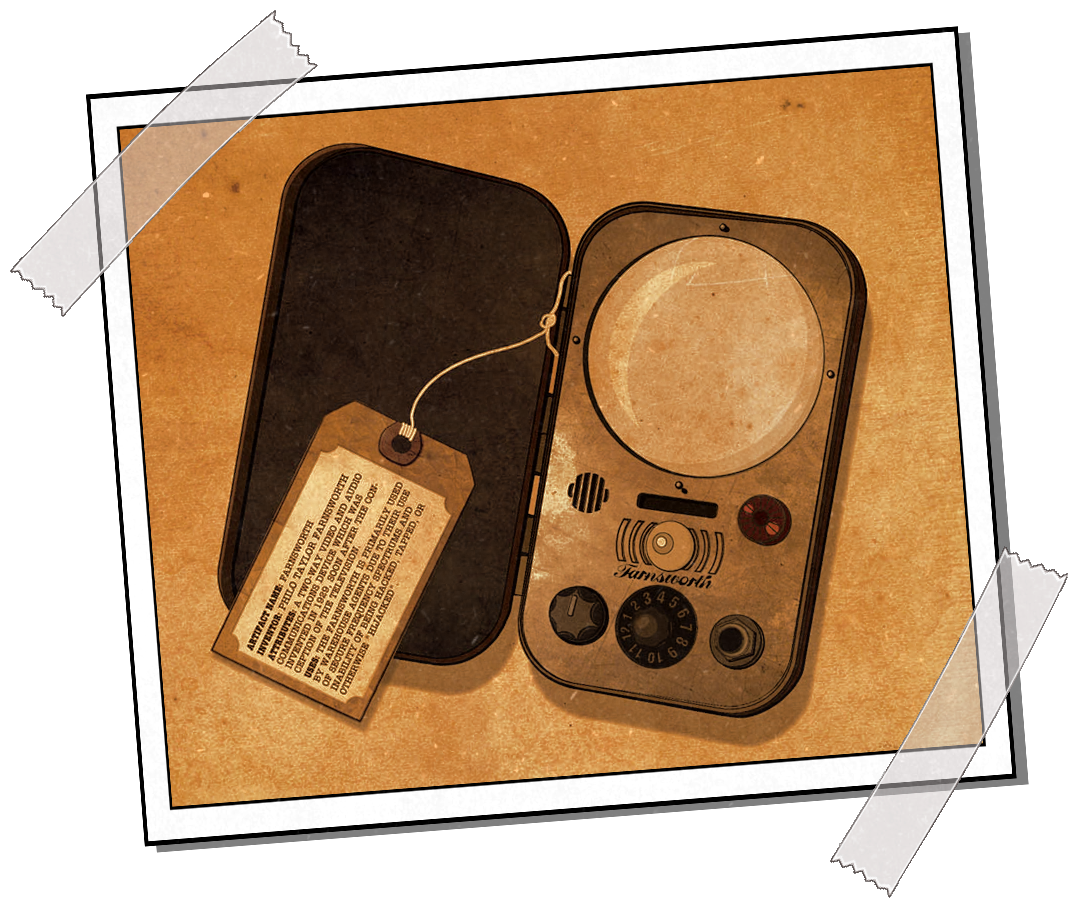
“This wasn’t invented when this was made.”
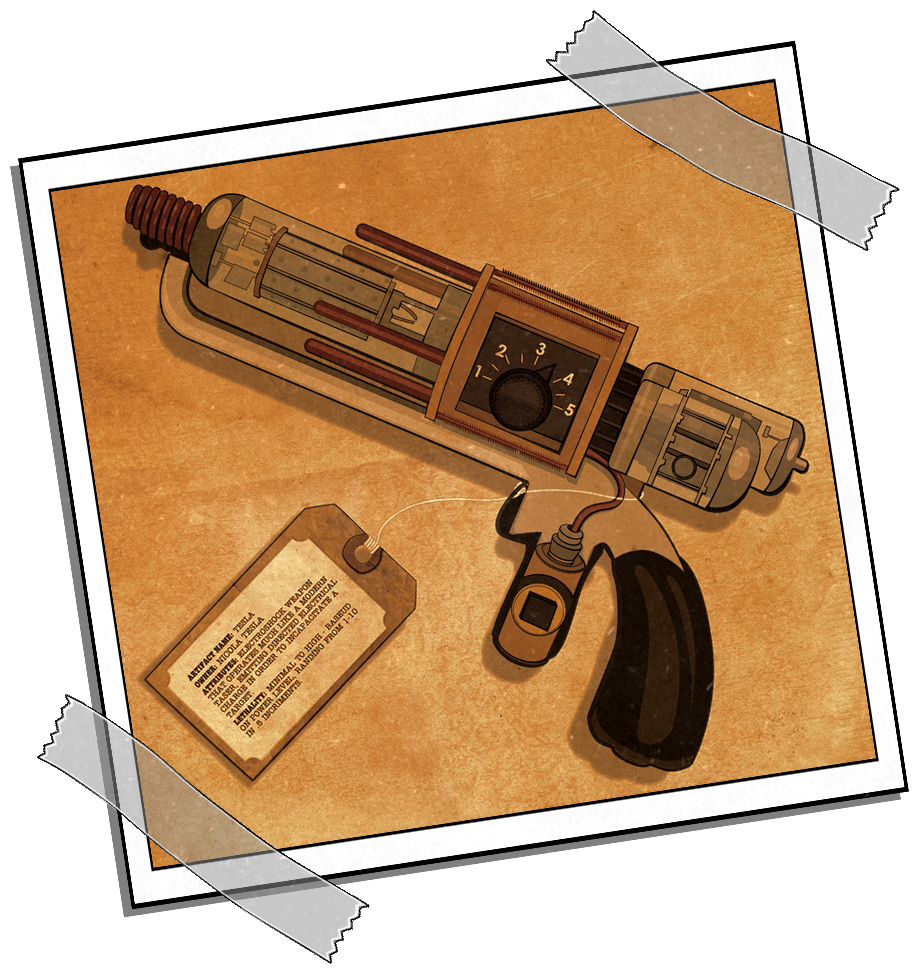
“There is always an alternative to killing.”
THE TESLA
Created by Nikola Tesla in the early 1890s as an alternative to bullets, the Tesla is a powerful electric stun gun. It fires an electric pulse, the strength of which varies depending on the level it is set to. (It is recommended to keep the level to two unless absolutely necessary.) This electric pulse is useful in a variety of situations; it can overload most modern electronics, forcing a shutdown, or incapacitate a target and scramble their short-term memory, making it extremely handy when it comes to hiding Archive activity.The Tesla’s main drawback, unfortunately, is its limited power capacity; even when fully charged, it can only manage one or two shots before requiring a recharge. Its battery is conveniently built into its carrying case, but it still takes a long time to charge. It is also difficult to aim; it is recommended agents practice using the Targeting Coil located in aisle Tesla-315, which will absorb any stray shots and prevent any unfortunate accidents.
THE AGENTS. (YOU!)
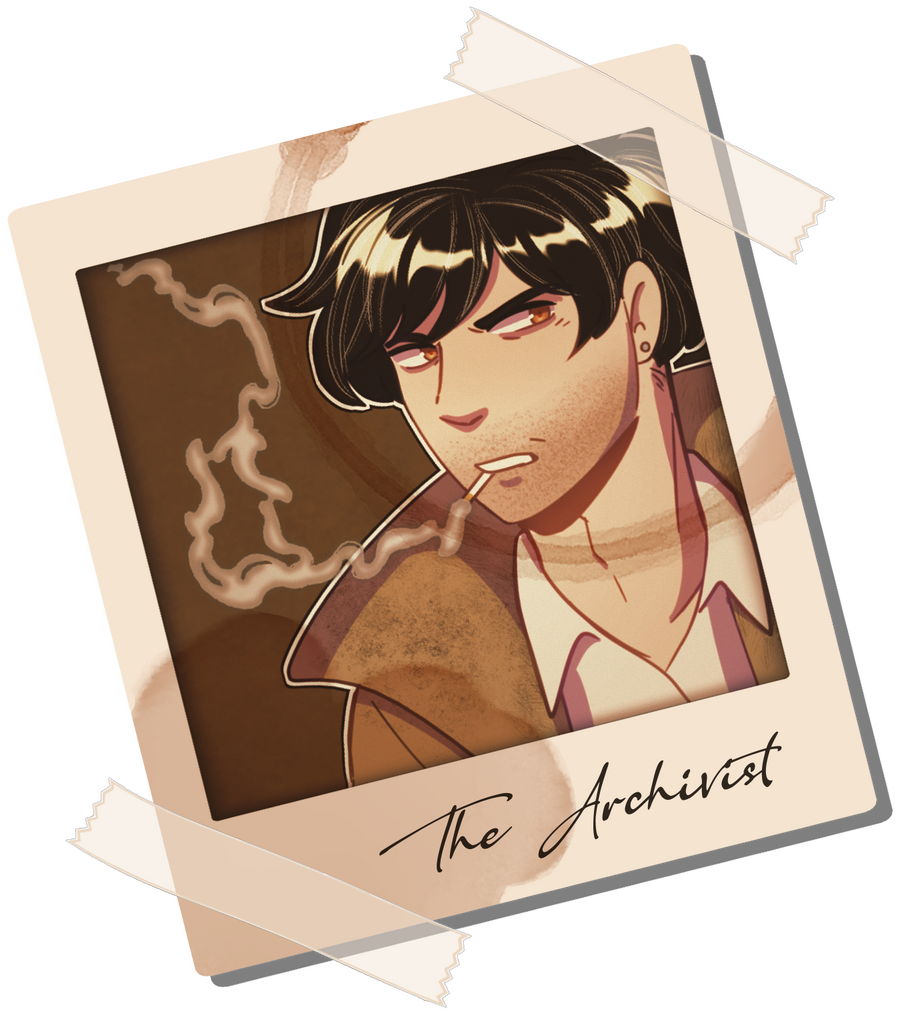
The Archive is only as good as the Agents that work there. Archive agents are responsible for investigating disturbances picked up by the Archive’s worldwide surveillance system, locating the artifact responsible, and bringing it to the Archive to safely store it away. These missions can vary in complexity, from simply winning the object at an auction or taking it from an individual to breaking into a museum and swapping a real artifact for a duplicate. Their objective—your objective—is simple in practice, difficult in execution: find the artifact that threatens disaster and bring it to the Archive where it cannot do any harm.
▶ CHOOSING AGENTS.
As the Archive is, technically, a branch of the United States government, it often sources its agents through other United States agencies, such as the CIA, FBI, ATF, SS, and so on. Agents transferred from one of these agencies already have firearm training, investigative experience, and are used to keeping secrets: three skills that already make them excellent candidates for Archive duty.However, the Archive seeks more than that. They look for a spark, something that makes people stand out above others. Perhaps they’re well-versed in literature, knowing the Bard’s words by heart, or they’re exceptionally skilled at finding their ways around firewalls and other security measures. Maybe they have a sharp eye for detail, never allowing anything to slip past them, or a good feeling of who might be trustworthy and who’s worth suspecting. Maybe they even have an instinct they can’t quite explain, an ability that transcends explanation.
Whatever that spark is, the Archive wants it.
Agents are most often employed after they themselves encounter an artifact and either manage to avoid becoming a victim of it or actively aid in its recovery by Archive agents. They are involved in a way that catches the Archive’s eye. Shortly after such an incident, if the Archive decides to bring them onto the team, they are visited by the Keeper, Eryl, who informs them of their new employment situation.
▶ THE BREACH.
The Archive doesn’t usually employ so many agents at once; the agency is meant to be a small team, as smaller numbers make it easier to protect the secrets they keep, and the Archive would not survive without its secrets.
Unfortunately, the Archive has been operating at a deficit for five years, as only one agent, the Archivist, remained after the Breach, the worst █████████████████ history. ██████████ defected ██████████ stealing artifacts ███████████████████████████████dead. ████████████████████ infighting ███████████████████████████████ Sanura ████████████████████████ █████████████████████████ ███ ██████████████████ ███████████████████

SYSTEM
Archive Zeta features RP events, referred to as Episodes, that can be run by mods and members alike. Most Episodes center around investigating an incident, finding the artifact that caused it, and bringing it back to the Archive. Agents must work together to “snag, bag, and tag” the artifact causing trouble before it causes an irrevocable disaster.All Archive missions are conducted in secrecy. At least, as much secrecy as the agents can manage. The outside world must not know about artifacts and their properties. Agents may work under the guise of government agencies (either their former agency or a cover the Archive provides) to gain access to information, but the nature of their work requires them to garner as little attention as possible.During an Episode, agents explore different locations, speak to witnesses, and gather Clues using their Specialties by rolling 2D6. An agent’s Specialty refers to their thought process when it comes to making decisions—what knowledge they draw on to understand the issue, and how it drives them to proceed. Every Specialty correlates with a type of Clue—information that helps the agents piece together the story behind the investigation.While agents can roll for any kind of Clue, those whose Specialty matches the Clue at hand may roll with a +1 bonus. A successful roll earns them a new Clue to the artifact’s identity (and a bonus on certain rolls in the final stage of an Episode). Gathering as many Clues as possible gives agents an edge when they finally confront the artifact.
While you are free to get more specific about what your agent’s Specialty entails,
all Specialties fall into one of four broad categories:

Logic specialties rely on facts and figures, what they know and what they see. They are exceptionally good at spotting discrepancies in stories and environments, often picking up what others miss. They come to conclusions and make decisions based on their own deductions of the situation at hand.
Intuition specialties pay more attention to their gut instinct than any concrete evidence. They are great at reading the room, often relying on “vibe checks” to determine whether someone is trustworthy or not. Some Intuition specialties even have some sort of sixth sense to aid in their investigation.


Lore specialties know how to research. They are usually well-versed in a particular topic—a certain historical time period, a genre of literature, a specific media, etc. As nearly all artifacts leave behind some kind of historical paper trail, those with the Lore specialty are invaluable for any investigation.
Tech specialties are experts with technology, mechanics, computer systems and the like. They solve their problem by turning to machinery, whether it’s digging into a server to find the right information or using a tool to crack open a safe. Man is a tool-using animal, and Tech is a tool-using specialty.

Similarly, there are four types of clues with correlate with their respective Specialty:


Evidence. Traces the artifact has left behind, or a clue that might lead the agents to the Beholder. (This includes odd smells—for some reason, many artifacts often leave behind the smell of fudge.) It can also point towards something that is out of place in an area—a pencil in a pen cup, an upside-down book on a shelf, the outline of a secret door.Suspects. Everyone is a suspect, even those that seem to have nothing to hide—not everyone will know they’re using an artifact. It’s useful to know, then, who is and isn’t lying—but be forewarned that just because someone has something to hide doesn’t mean it has anything to do with the artifact. A witness may have their own reasons to keep their secrets.Research. Cross-referencing information found in an investigation with information found in history can be an effective way to figure out what, exactly, an agent is looking for. Artifacts are dotted through history, therefore history itself can be a useful guide. Every artifact is an extension of a person—understand the person, understand the artifact. Don’t underestimate the power of niche knowledge!Communication. There’s some information only the Archive can access, whether it’s hidden behind secure servers or intelligence grounded in the knowledge of artifacts themselves. Presenting a successful query to the Archive’s mission control (usually the Archivist himself) will earn agents a hint in the right direction. An unsuccessful query will lead nowhere.
Finding the artifact is only half the battle; agents must often face off with the Beholder using the artifact or even the artifact itself. Agents may only collectively roll three times when retrieving the artifact; a successful roll means a successful snag. Three unsuccessful rolls, however, mean the artifact has been lost and agents must return to the Archive emptyhanded.
RESOURCES
GET STARTED.
ARCHIVE RESOURCES.
ARCHIVE'S MOST WANTED.
WARNING! These former Archive agents, collectively referred to as Breach Agents, should be approached with caution. They are armed with powerful artifacts and are highly dangerous. If a living Breach agent is encountered on a mission, Archive agents are commanded to capture and bring them to the Archive for immediate imprisonment in the Bronze Sector by order of the Synod.


████████████████████████ █████████████████████████ ███ ████████████ ███████████████████ ████████████ ████████████ ███ ███ ███████████████ ████████████ ████████████ ███ █████ ███████████████ ██████ █████████ ███ ████████████ ██████ ████████████ ████████████ ███████ ███ ███████
CLEARANCE INSUFFICIENT. ACCESS DENIED.